Maintenance jobs in business aviation
After any work on it, a jet only flies again once a technician holding the right licence has signed it off. The whole trade is built around that licence, and yet some jobs open up before you hold it.
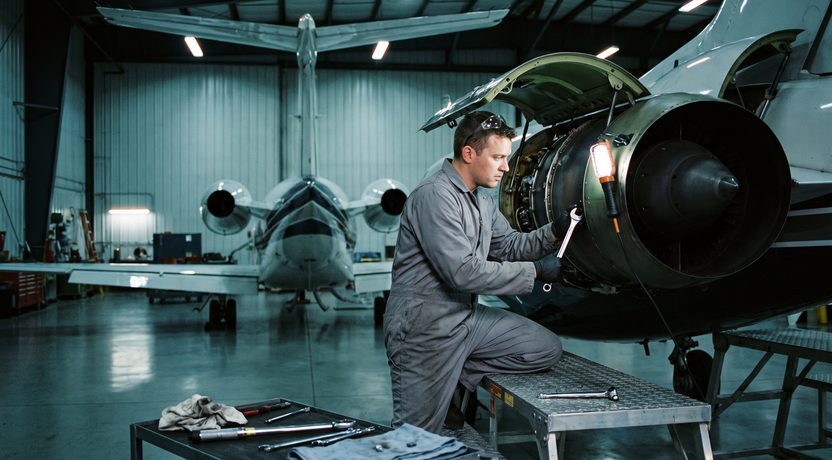
- Whether in the hangar or the office, maintenance teams make sure each aircraft stays airworthy.
- The central title is the Part-66 licence, issued by the civil aviation authority.
- You earn it through basic knowledge exams and practical maintenance experience.
- Category B1 covers the structure and engines, category B2 the avionics.
- Some posts open without a licence and give you the experience it requires.
Joining the maintenance side means choosing between the hangar, the ramp and the offices that track each aircraft's condition, because looking after a business jet is shared between those three places. The work can be done on a grand scale, too, since one of the major business aviation maintenance shops has seven hangars and 640 specialists, according to its website.
- Whether in the hangar or the office, maintenance teams make sure each aircraft stays airworthy.
- The central title is the Part-66 licence, issued by the civil aviation authority.
- You earn it through basic knowledge exams and practical maintenance experience.
- Category B1 covers the structure and engines, category B2 the avionics.
- Some posts open without a licence and give you the experience it requires.
On this page
What does maintenance work involve?
Maintenance keeps the aircraft fit to fly, and it brings together two kinds of work that do not happen in the same place.
The first is maintenance itself, entrusted to a maintenance shop approved by the civil aviation authority. There you carry out inspections and replace parts, track down faults and repair the structure.
The second is continuing airworthiness management, meaning everything that keeps the aircraft compliant and safe at every point in its life. This is the work of a CAMO, the organisation approved to manage that airworthiness, and its posts are office-based.
| Maintenance | Airworthiness management | |
|---|---|---|
| Who | An approved maintenance shop | A CAMO |
| Where | On the ramp and in the hangar | In the office |
| What | Inspections, parts, faults, repairs | Maintenance programme, technical records, airworthiness directives |
The maintenance programme sets out what must be done on the aircraft and when, while airworthiness directives are the measures an authority makes mandatory for an aircraft type.
Within maintenance, there is also a split between line and base. Line maintenance is done on the apron, between two flights, whereas base maintenance covers the heavy checks that keep the aircraft in the hangar.
What is different in business aviation?
Business aircraft often fly far from their base. An aircraft grounded by a fault is said to be AOG, short for aircraft on ground, and when that happens away from home, a technician travels out to fix it.
Some jobs also involve the bespoke fitting out of aircraft interiors for private clients, from the seats to the furniture and cabin systems. The trade calls this work completions.
Which licence do you need?
The central title is the aircraft maintenance licence, known as Part-66. It is what allows you to sign the certificate of release to service, the document stating that the aircraft can fly again after work on it.
The licence comes in categories, and four of them matter for business aircraft.
| Category | What it covers |
|---|---|
| A | Simple scheduled line maintenance and simple defect rectification, for the tasks the maintenance shop authorises |
| B1 | The structure, the engines and the mechanical and electrical systems |
| B2 | Avionics, meaning the electronics on board, and electrical systems |
| C | Certifying the aircraft as a whole after base maintenance |
Other categories exist for light aircraft, and to certify work on a specific aircraft type, the licence must also carry that type rating. The page on the Part-66 licence explains what each category lets you sign for.
How do you get the licence?
You get the licence through exams and experience, then add to it one aircraft type at a time.
- Pass the basic knowledge exams, at an approved maintenance school or with the civil aviation authority.
- Show practical experience, gained by working in maintenance under the signature of a licence holder.
- Receive the licence from the civil aviation authority, the DGAC in France.
- Add the type rating, after a course on the aircraft model.
If you have completed a basic training course at an approved maintenance school, you need less practical experience.
In the United States, the equivalent is the mechanic certificate issued by the FAA, the American civil aviation authority. It carries two ratings, airframe for the structure and powerplant for the engines, which is why it is known as the A&P.
Top tip Some technician posts are open without a licence, and the experience the licence asks for is gained precisely by working in maintenance, under a licence holder's signature. Look out for these posts in the adverts: they can be your first step towards the licence.
Which job titles should you look for?
Operators and maintenance shops usually write their adverts in English, with job titles that are well worth knowing before you start searching.
| Job title | What it means |
|---|---|
| Licensed Aircraft Engineer | A licence holder who signs releases to service, often with category B1 or B2 specified |
| Aircraft Technician, Maintenance Technician | The technician who carries out the tasks, with or without a licence depending on the post |
| Avionics Technician | The specialist in avionics and electrical systems, the field of category B2 |
| Line Maintenance, Base Maintenance | Two labels that show whether the post is on the ramp or in the hangar |
| Continuing Airworthiness Engineer | An office role in a CAMO, following the maintenance programme and the directives |
| Technical Records | Keeping the technical records of each aircraft |
| Interior Technician, Completions | Fitting out and repairing interiors |
What is the working pattern like?
The pattern depends on the post, and it is less regular on the ramp than in the office.
In line maintenance, the work follows the flights, and teams cover the hours when the aircraft is on the ground, nights included. In base maintenance, a heavy check occupies the hangar for a long stretch, with teams taking over from one another, while AOG call-outs add unplanned trips, sometimes abroad.
Office roles in airworthiness management keep more regular hours. Depending on the operator, they may include standby duty, to answer crews and technicians when an aircraft is stuck far from its base.
What next?
- The maintenance jobs: this week's adverts from the operators and maintenance shops we follow, with a link to the original advert.
- The CAMO: the office-based job that keeps track of each aircraft's airworthiness.
- The Paris Le Bourget page: the airport, its FBOs and the companies based there.
Every Monday, new jobs and fresh articles await you on The Crew Talk, and we would be delighted to see you there.
Who is hiring right now
Figures from the open jobs, updated every morning.
Where: United States (124), Canada (37), Switzerland (21)
Most common job titles: Aircraft Maintenance Technician (14), Maintenance Manager (5), Licensed Avionics Technician (5)
More on this job family
5 articles →Going further
- Regulation (EU) No 1321/2014 on continuing airworthiness, Annexes I (Part-M), II (Part-145), III (Part-66), IV (Part-147) and Vc (Part-CAMO), consolidated version. eur-lex.europa.eu, accessed 17 October 2026.
- EASA, Continuing Airworthiness Organisations. easa.europa.eu, accessed 17 October 2026.
- EASA, AMC and GM to Annex III (Part-66) of Regulation (EU) No 1321/2014. easa.europa.eu, accessed 17 October 2026.
- eCFR, 14 CFR Part 65, Subpart D, Mechanics. ecfr.gov, accessed 17 October 2026.
- Dassault Falcon Service, Our company. dassaultfalconservice.com, accessed 18 October 2026.