Cabin crew in private aviation
In private aviation, you welcome a few guests into a cabin that feels like a drawing room, and you turn every meal on board into a proper occasion. Here is what the job asks of you, what makes the difference and how to prepare for it.

- In private aviation, you look after a few guests, often alone in the cabin.
- The whole job revolves around Silver Service and the particular codes of private service.
- You also look after safety, and each operator trains you on its aircraft.
- The year runs in rotations, often known several months ahead.
- Operators really value proper training, since that is where you learn the cabin's codes.
In private aviation, the job plays out on an intimate scale: a Dassault Falcon 2000, one of the French maker's business jets, has no more than 19 seats for its guests. You welcome a few people, prepare each flight around them and turn the meal on board into something worthy of a fine table. It is above all a service role, one that calls for discretion and a genuine fondness for people.
- In private aviation, you look after a few guests, often alone in the cabin.
- The whole job revolves around Silver Service and the particular codes of private service.
- You also look after safety, and each operator trains you on its aircraft.
- The year runs in rotations, often known several months ahead.
- Operators really value proper training, since that is where you learn the cabin's codes.
On this page
What does a flight attendant in private aviation do?
You run the whole service, from the welcome at the door until your guests step off at the other end. Before the flight, you place the catering order, the food and drink chosen for that journey, with a specialist aviation caterer. You then prepare the cabin and, once airborne, plate the dishes in the galley, the aircraft's compact kitchen, before serving them at the table.
You also look after your guests' safety, like every member of a cabin crew. You give the safety briefing before departure, and you know how to run an evacuation with the equipment on board. These skills are learnt aircraft by aircraft, because two aircraft from different manufacturers have neither the same door nor the same emergency equipment.
What really makes the difference?
The standard of your service, first and foremost, because your guests expect on board the same attention they enjoy in the finest hotels and restaurants.
- Silver Service: the whole art of table service on board, from laying the table to porcelain, crystal and silverware, through to platter service, wine and etiquette. Our Silver Service article covers it in detail.
- The codes of private service: discretion, anticipation and the knack of being present without ever intruding.
- Presentation: an immaculate uniform and a calm, gracious manner.
- English: confident conversational English, the working language on board and with operators, the business aviation firms that run the jets, though you needn't be bilingual.
- Mobility: missions begin wherever the aircraft happens to be.
A real sense of service is the condition for all of this, not a substitute for it. These codes are acquired through proper training, which operators particularly value.
Can you start without ever having flown?
Yes, because private aviation asks for neither seniority nor flying hours, and operators train their crew on their own aircraft. A background in high-end service is even among the most valued, at any age, since European rules set no upper age limit for cabin crew. Whatever your path, it is training that gives you the codes of the cabin.
Our articles look at each of these routes:
- From luxury hotels to the cabin
- From fine dining to onboard service
- From yachting to private aviation
- A new career at 30, 40 or 50
- Already cabin crew: moving into private aviation
Who decides when you fly, and at what pace?
Flights follow your guests' plans, while your year takes shape well in advance. The aircraft flies for its owner, or for a client who hires it with its crew. That is called charter, and only an operator holding an air operator certificate can offer it. Private owner or operator explains what that framework changes for you.
Your job is attached to a base, the airport from which most of the aircraft's or the fleet's flights depart. The year is usually organised in rotations, the most common being fifteen days on mission followed by fifteen days entirely free. That roster, the crew calendar, is often known several months ahead, sometimes up to a year. An outbound flight may then be followed by several nights away before the return.
Which job titles should you look for?
Operators usually write their adverts in English, and the same job may go by a different name from one to the next. Our guide to cabin crew job titles shows you how to decode them.
- Corporate Flight Attendant: the classic title in business aviation.
- VIP Flight Attendant: the same job, with the emphasis on service to private clients.
- Cabin Host, Cabin Hostess or In-flight Service Personnel: in-house titles used by some operators.
- Purser, Chief Purser or Cabin Manager: the person who leads the cabin when there are several crew.
Where do you start?
Here are the steps that most often lead to a first role.
- Train in Silver Service and the codes of private service, the foundation of the job.
- Keep your conversational English sharp, until it feels completely natural.
- Prepare a one-page CV and a polished photo designed for business aviation, with the help of our CV guide.
- Write to operators, whom you will find country by country in our directory, whether or not they have advertised a role.
Top tip Since the operator trains you on its own aircraft, you can apply without already being qualified on a particular jet. What will set your application apart is proper Silver Service training, so put it right at the top of your CV.
The Silver Cabin Institute, linked to the publisher of The Crew Talk, offers online training in onboard service and Silver Service, to follow at your own pace. One-to-one mentoring then takes over, from a CV rewritten for private aviation to preparing each interview, until your first flight and for up to a year. The programme is presented at the bottom of this page.
What next?
- How to become a flight attendant in private aviation: your guide to getting started.
- Cabin crew jobs: this week's openings with operators.
- Paris Le Bourget: the airport, its FBOs and the operators linked to it.
Cabin crew jobs and our articles are refreshed every Monday, and we would be delighted to see you back on The Crew Talk.
Who is hiring right now
Figures from the open jobs, updated every morning.
Where: United States (20), Switzerland (5), Luxembourg (4)
Most common job titles: VIP Flight Attendant (7), Cabin Attendant (4), Flight Attendant (3)
More on this job family
19 articles →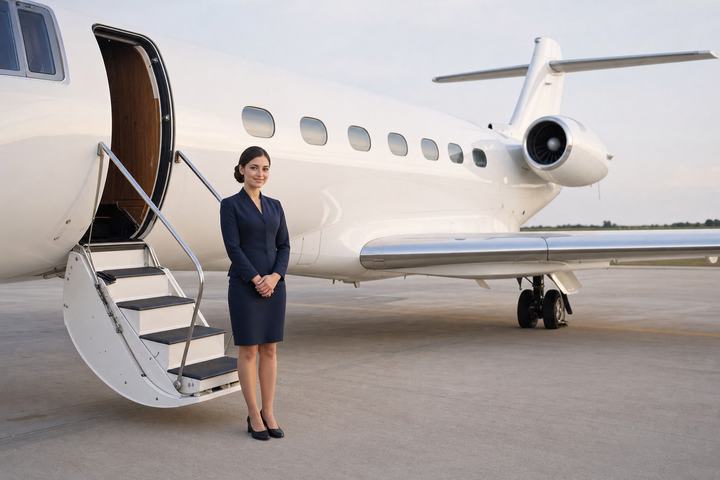





Going further
- Regulation (EU) No 965/2012 on air operations, Annex I (definitions) and Annex III (Part-ORO), consolidated version. eur-lex.europa.eu, accessed 17 October 2026.
- EASA, FAQ on aircraft type specific training and operator conversion training (Part-ORO). easa.europa.eu, accessed 17 October 2026.
- EASA, Non-commercial operations with complex motor-powered aircraft (Part-NCC). easa.europa.eu, accessed 17 October 2026.
- EASA, Regulation 965/2012, classification of operations and applicability of the annexes. easa.europa.eu, accessed 17 October 2026.
- EASA, Type Certificate Data Sheet EASA.A.008 Falcon 2000, Issue 12, 11 June 2026. easa.europa.eu, accessed 18 October 2026.