Pilot in business aviation
The flight deck of a business jet calls for a professional licence and the type rating for the aircraft. The job is done with a small crew, on-demand flights and destinations that change from one trip to the next. On a jet that flies without cabin crew, you even welcome the guests yourself.
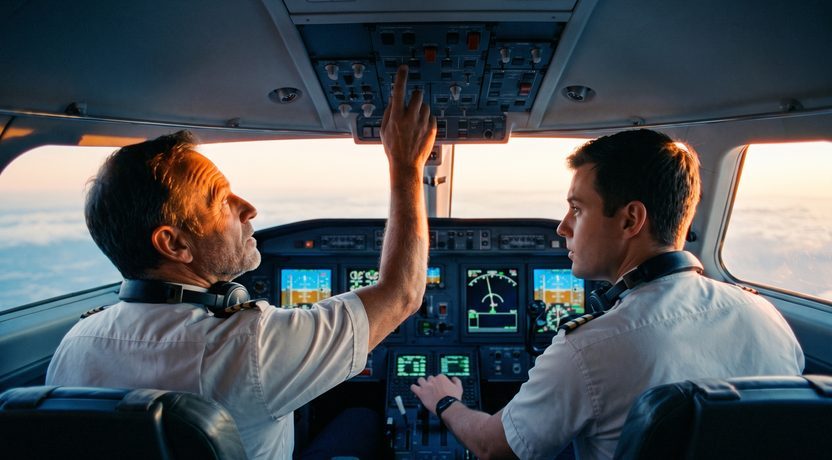
- You plan and fly on-demand flights, usually as one of two pilots.
- A professional licence, either the CPL or the ATPL, is the starting point.
- Each jet model also calls for its own type rating.
- Licences and ratings come from an ATO, a training organisation holding official approval.
- Each operator adds a conversion course, then training and checks every year.
Flying a business jet is a job of licences and rigour, done in an intimate setting and close to the guests. The standards are exacting: the Dassault Falcon 2000's type certificate data sheet, published by EASA, the European Union Aviation Safety Agency, sets a minimum crew of two pilots. Each of them must hold the type rating for that model and, on a charter flight, a professional licence.
- You plan and fly on-demand flights, usually as one of two pilots.
- A professional licence, either the CPL or the ATPL, is the starting point.
- Each jet model also calls for its own type rating.
- Licences and ratings come from an ATO, a training organisation holding official approval.
- Each operator adds a conversion course, then training and checks every year.
On this page
What does a pilot do in business aviation?
You plan the flight and then fly it, usually as one of a crew of two. The crew is generally made up of a captain, responsible for the flight and the crew, and a first officer, who shares the flying.
There is no published timetable, because the aircraft owner books the flights, or a client hires the aircraft with its crew. The destination changes from one flight to the next, and each airfield has to be prepared on its own terms.
What does the job ask of you beyond flying?
The crew is small, and on aircraft that fly without cabin crew, you look after the guests yourself. Each trip also calls for arrangements specific to the destination, from overflight permits and slots to ground handling and fuel. Depending on the operator, this is done in house or handed to a trip support company, which specialises in organising flights.
There are also two kinds of flight. When a client hires the aircraft with its crew, it is called charter, a kind of flight that only an operator holding an air operator certificate may operate. A company or a private owner can also fly its own aircraft, and those flights then usually follow the rules for flying on one's own account.
Which licence do you need?
To fly for a living, you need a professional pilot licence. These licences are European, and three of them matter most in business aviation.
| Licence | What it allows, among other things |
|---|---|
| CPL, the commercial pilot licence | On charter flights, co-pilot, or captain of a single-pilot aeroplane; on other flights, captain or co-pilot |
| ATPL | Captain on charter flights, on an aeroplane operated by two or more pilots |
| MPL, the multi-crew pilot licence | Co-pilot on an aeroplane that must be flown with a co-pilot |
The road to these titles, from the private pilot licence to the type rating, is set out step by step in pilot licences, in order.
What else do you need besides the licence?
A licence is not enough on its own, because you also need ratings and a language endorsement.
- The IR, the instrument rating, to fly under instrument flight rules.
- The type rating, specific to each aircraft model. You may only fly an aircraft with a valid class or type rating for it, and EASA publishes the lists of these ratings.
- The language proficiency endorsement, in English or in the language used for radio communications on the flight.
Where do you train for licences and ratings?
You train for licences and type ratings at an ATO, an approved training organisation, meaning one the authority has allowed to train pilots. In France, that authority is the DGAC, the French civil aviation authority.
For a type rating, look for an ATO that runs the course on the aircraft model you are aiming for. If you already have a flying career behind you, what changes on the flight deck shows you what such a course looks like on a business jet.
What happens once you are hired?
Each operator then adds its own steps, set by the European rules on air operations:
- the operator conversion course, when you join;
- training and checks on the aircraft type, every year.
Good to know Recurrent training and checks often mean a trip to a centre with a simulator for the aircraft type.
Which job titles should you look for?
Operators usually write their adverts in English, with job titles that are well worth recognising at a glance.
| Job title | What it means |
|---|---|
| Captain | The pilot in command, responsible for the flight and the crew |
| First Officer | The co-pilot, who shares the flying with the captain |
| Type Rated Captain, Type Rated First Officer | The same jobs, with the type rating already required |
| Pilot in Command, Second in Command | Another way of writing captain and co-pilot |
| Line Captain | A captain assigned to regular flights rather than training posts |
| Ferry Pilot | A pilot who moves an empty aircraft, to a maintenance shop or a new owner |
| Helicopter Pilot | For operators that also have helicopters in their fleet |
Top tip Look out for the words Type Rated in the job title, which tell you the type rating is required from day one. Then sort the adverts by the model they ask for, and the posts that match your own rating will stand out straight away.
What is the working pattern like?
Your job is attached to a base, the airport from which most of the aircraft's or the fleet's flights depart. The year is usually organised in rotations, a period on duty followed by a period entirely free. The operator publishes them in the roster, the crew schedule, which is often known months in advance.
Within your duty days, only the flights depend on your guests' plans, and part of your time may be spent on standby. You then stay ready to leave within a time set by the operator.
A trip can last several days, with nights away between the outbound and return legs. On charter flights, the European rules set limits on crew flight and rest times.
What next?
- Pilot jobs: this week's adverts from the operators we follow, with a link to the original advert.
- The operator directory: operators country by country, based on the official lists published by the authorities.
- Malta: the operators based on the island, set apart from those that only hold their certificate there.
Every Monday, new pilot jobs and fresh articles await you on The Crew Talk, and we would be delighted to see you there.
Who is hiring right now
Figures from the open jobs, updated every morning.
Where: United States (163), Canada (24), Germany (15)
Most common job titles: Captain (20), Pilot (14), First Officer (9)
More on this job family
6 articles →Going further
- Regulation (EU) No 1178/2011, Article 2, Article 10a and Annex I (Part-FCL), consolidated version. eur-lex.europa.eu, accessed 17 October 2026.
- EASA, Class and Type Rating and Endorsement lists. easa.europa.eu, accessed 17 October 2026.
- Regulation (EU) No 965/2012 on air operations, Annex III (Part-ORO), Subpart FC, consolidated version. eur-lex.europa.eu, accessed 17 October 2026.
- EASA, Non-commercial operations with complex motor-powered aircraft (Part-NCC). easa.europa.eu, accessed 17 October 2026.
- EASA, Regulation 965/2012, classification of operations and applicability of the annexes. easa.europa.eu, accessed 17 October 2026.
- EASA, Type Certificate Data Sheet EASA.A.008 Falcon 2000, Issue 12, 11 June 2026. easa.europa.eu, accessed 18 October 2026.