Training and instruction in business aviation: the titles you need and where to earn them
Pilot instructor, examiner, cabin crew, maintenance or air traffic control trainer: every field has its own titles for passing on your trade. Here they are, along with where to train for them and the job titles you will see in adverts.
- In business aviation, pilot instruction centres above all on the type rating.
- Flight instructors hold an instructor certificate on top of their pilot licence.
- That certificate requires age 18 and is usually valid for three years.
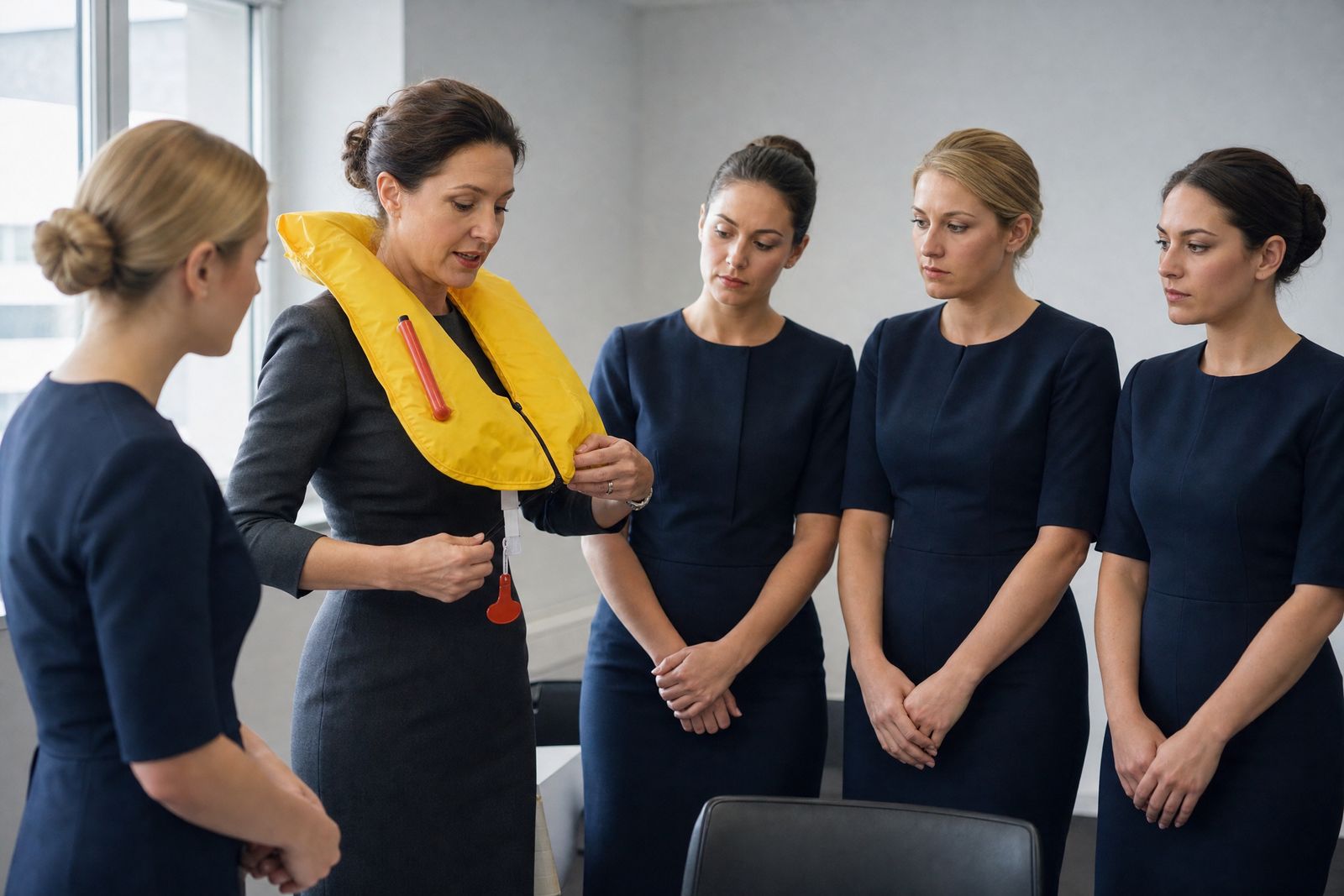
- Cabin crew trainers teach at an approved operator or training organisation.
- In air traffic control, only controllers with an OJTI endorsement train on live positions.
If you are thinking of teaching your trade in business aviation one day, you will usually do so after practising it. In most fields, the trainer title builds on experience you already have, and each field sets its own rules.
- In business aviation, pilot instruction centres above all on the type rating.
- Flight instructors hold an instructor certificate on top of their pilot licence.
- That certificate requires age 18 and is usually valid for three years.
- Cabin crew trainers teach at an approved operator or training organisation.
- In air traffic control, only controllers with an OJTI endorsement train on live positions.
On this page
In Europe, for instance, a pilot must be at least 18 and hold a pilot licence and an instructor certificate to instruct in an aircraft. That certificate comes in nine categories, from the FI, who teaches student pilots, to the TRI, who trains pilots on one specific aircraft model.
Who trains whom in business aviation?
Every field has its trainers, and for pilots and air traffic controllers alike, the instructor title sits on top of a licence you already hold.
| Field | Who trains | What it takes |
|---|---|---|
| Pilots | Instructors and examiners | An instructor certificate, plus a licence to instruct in the aircraft |
| Cabin crew | Trainers at an approved organisation or operator | Experience and qualifications for what you teach |
| Maintenance | Instructors at approved schools | Training in the subject and in teaching methods |
| Air traffic control | Controllers with an OJTI endorsement | The controller licence and that endorsement |
What do pilot instructors do?
On the pilot side, training covers several jobs. A flight instructor teaches student pilots to fly, in the aircraft, while a type rating instructor trains pilots who already hold a licence on one specific aircraft model. A synthetic flight instructor does similar work in a simulator, without leaving the ground.
Examiners, for their part, conduct the skill tests that grant or extend a licence or rating. They hold their own certificates, alongside the nine instructor categories.
In business aviation, most of the work goes to type rating instructors and simulator instructors, because a jet pilot flies with a rating specific to that model. Here are four abbreviations well worth knowing.
| Abbreviation | What it means |
|---|---|
| FI | The flight instructor, who teaches students |
| TRI | The type rating instructor, for pilots who already hold a licence |
| SFI | The synthetic flight instructor, who teaches only in a simulator |
| TRE | The type rating examiner |
How do you become a pilot instructor?
To instruct in an aircraft, you need a pilot licence and the right instructor certificate, whereas to instruct in a simulator, the certificate alone is enough.
- Be at least 18.
- Hold the licence and rating you will teach for, to instruct in an aircraft, with experience on the class or type of aircraft, or an assessment of competence instead.
- Complete the instructor course, theory and flying, at an ATO, an approved training organisation.
- Pass an assessment of competence at the end of the course.
Once issued, the instructor certificate is generally valid for three years.
Good to know The instructor title is not where you start. A licensed pilot first builds the experience required on their class or type of aircraft, and only then takes the instructor course at an approved organisation.
What happens at a business aviation operator?
At an operator holding an AOC, the air operator certificate, crew training is overseen by a person nominated to the authority. It is one of the main areas the operator places under a named manager, and its training captains train and check the other pilots.
How does training work for cabin crew, maintenance and air traffic control?
For cabin crew, the training set out in the European rules is delivered by training organisations or by operators that hire out their aircraft. All of them are approved by the authority and bound by the programme written into their approval. Each operator then runs its own courses, tied to its aircraft and procedures.
To train cabin crew, you need experience and qualifications suited to what you teach, within an approved organisation or operator. The path therefore runs through experience first, then through the qualification the employer expects of its trainers.
In maintenance, approved schools provide the basic training that leads to Part-66 licences, the European licence for maintenance technicians, and they also run training specific to each aircraft type. Their instructors must be trained both in their subject and in teaching methods.
In air traffic control, practical training happens on live positions. Only a licensed controller with an OJTI endorsement, for on-the-job training instructor, may give it, provided they also meet experience and teaching skill requirements.
Top tip The rules for trainers are free to read, as EASA, the European Union Aviation Safety Agency, publishes them at no cost in its Easy Access Rules. Read the ones for your field before choosing a course: you will know exactly what will be expected of you.
Which job titles will you see in the adverts?
- Flight Instructor: teaches student pilots in the aircraft.
- Type Rating Instructor: trains licensed pilots on one specific aircraft model.
- Simulator Instructor: delivers training in a flight simulator.
- Type Rating Examiner: conducts type rating skill tests.
- Training Captain: a captain who trains and checks the pilots of their own operator.
- Cabin Crew Instructor: trains cabin crew, at a training organisation or within an operator.
- Theoretical Knowledge Instructor: teaches ground theory at a training organisation.
What is the working pattern like?
Instruction in the aircraft depends on the weather and on daylight, especially early in pilot training. Simulator work runs in scheduled sessions, at times that vary from one centre to another.
Simulator instructors work where the machines are, which can mean travel, while cabin crew trainers move between the classroom and cabin mock-ups.
What next?
- The training jobs: this week's posts from the operators we follow, with their exact titles.
- Cabin crew in private aviation: the cabin job itself, whose experience you pass on once you become a trainer.
- Business aviation pilots: the licences and the type rating you need before you instruct on a jet.
We publish new jobs and fresh articles every Monday, so do come back and see us on The Crew Talk.
Who is hiring right now
Figures from the open jobs, updated every morning.
Where: United States (6), Malta (4), Namibia (2)
Most common job titles: Ground Instructor (2), CIMA Training Manager (1), Junior Training Coordinator (1)
More on this job family
2 articles →Going further
- EASA, Easy Access Rules for Aircrew (Regulation (EU) 1178/2011), contents of Subparts J and K. easa.europa.eu, accessed 17 October 2026.
- EASA, Easy Access Rules for Aircrew, FCL.900, FCL.915, FCL.930, FCL.940. easa.europa.eu, accessed 17 October 2026.
- EASA, Easy Access Rules for Aircrew, CC.TRA.215 Provision of training. easa.europa.eu, accessed 17 October 2026.
- EASA, Part-ORA, Annex VII to Regulation (EU) 1178/2011. easa.europa.eu, accessed 17 October 2026.
- EASA, AMC and GM to Part-147, Issue 2, Amendment 3. easa.europa.eu, accessed 17 October 2026.
- Regulation (EU) 2015/340, Subpart C, ATCO.C.005 and ATCO.C.010 (consolidated text, legislation.gov.uk). legislation.gov.uk, accessed 17 October 2026.
- EASA, Easy Access Rules for Air Operations, ORO.AOC.135 Personnel requirements. easa.europa.eu, accessed 17 October 2026.