Air traffic control and flight information: the jobs that guide business aviation, and the ways in
A business jet is handed from one controller to the next, from taxiing to landing, and this is not a job you can train for on your own, since it almost always begins with being recruited.
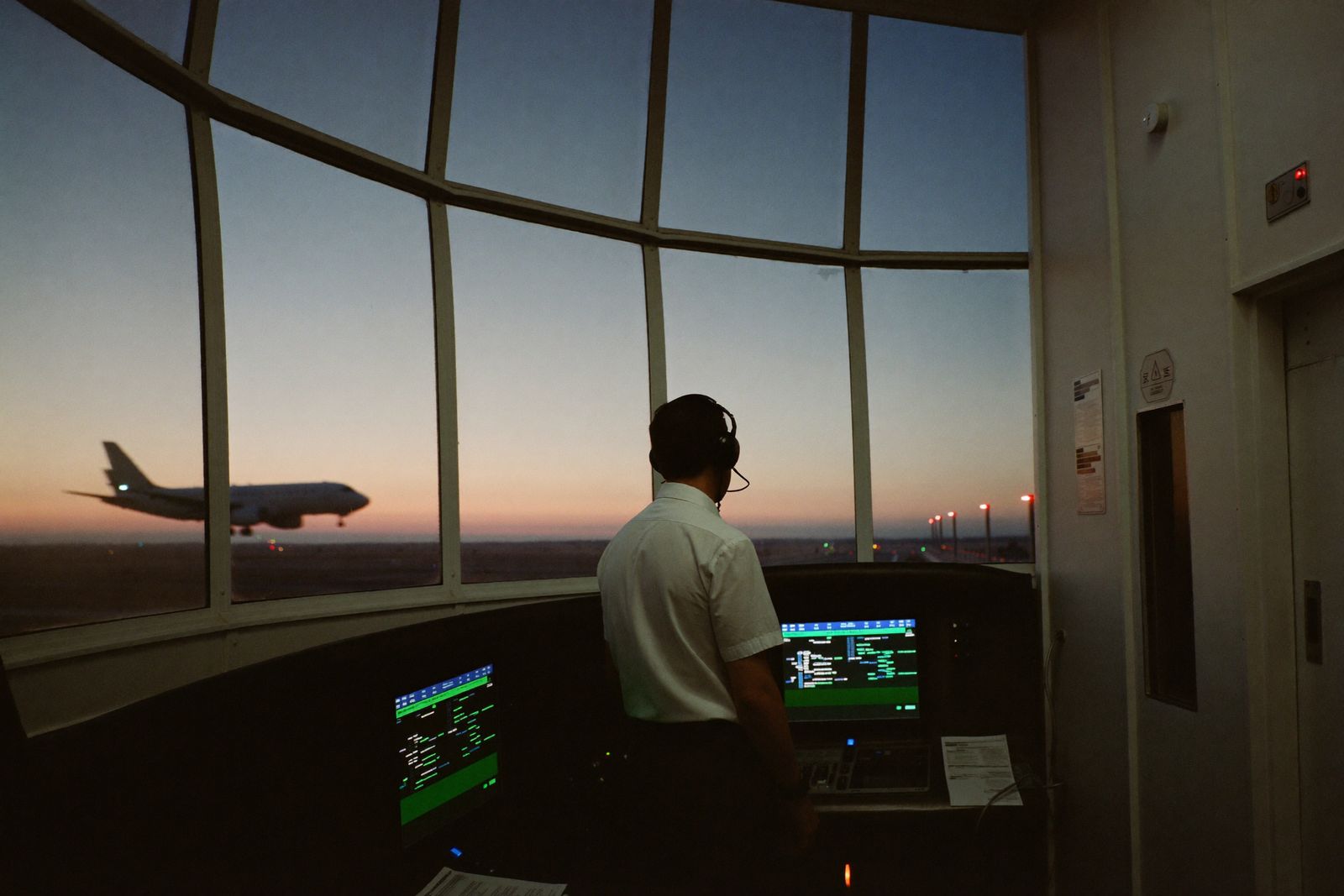
- Whether aircraft are taxiing or airborne, the controller's job is to keep them safely separated.
- In Europe, the licence is earned in two stages, from the age of 18.
- In France, the way in is the ICNA exam, usually after scientific preparatory classes.
- AFIS officers inform pilots at airfields without control, under a national licence.
- The work runs in shifts, nights and public holidays included.
An air traffic controller gives pilots clearances and instructions so that aircraft stay apart, on the ground and in the air. Business aviation has no separate control system, so its jets go through the towers and centres that handle all air traffic. In France, controllers work for the DGAC, the French civil aviation authority, which recruits them by competitive exam and then trains them over several years.
- Whether aircraft are taxiing or airborne, the controller's job is to keep them safely separated.
- In Europe, the licence is earned in two stages, from the age of 18.
- In France, the way in is the ICNA exam, usually after scientific preparatory classes.
- AFIS officers inform pilots at airfields without control, under a national licence.
- The work runs in shifts, nights and public holidays included.
On this page
What does an air traffic controller do?
The work is split into three services, and each one corresponds to a rating, an entry written on the licence.
- Aerodrome control, from the tower, handles aircraft on the runways and taxiways and in the vicinity of the aerodrome.
- Approach control handles arrivals and departures.
- Area control, also called en route control, looks after aircraft in the cruise.
Approach and area control both come in two versions. The procedural version works without radar, while the surveillance version uses a display of aircraft positions.
What about flight information officers?
This is a different job, done at aerodromes where there is no air traffic control. The AFIS officer runs the aerodrome flight information service, passes pilots the information useful for their flight and raises the alert if an aircraft is in trouble. The job matters for business aviation, since jets also use small aerodromes where flight information sometimes takes the place of control.
An AFIS officer does not separate aircraft the way a controller does, and what they may say or ask varies from country to country. So does their licence, which remains a national one, as EASA, the European Union Aviation Safety Agency, found in a survey carried out in 2016. In Ireland, for example, the aviation authority issues a national licence that names the aerodrome where it may be used.
What licence do you need to control traffic?
In Europe you need a controller licence, which follows the same rules in every EU country and is earned in two stages.
- The student air traffic controller licence. You must be at least 18 and complete initial training at a certified training organisation, which starts with common basic training and then trains you for at least one service.
- The air traffic controller licence. It comes after a course at the centre or airport where you will work, which ends with examinations.
Every licence carries at least one rating and an English language endorsement, with a minimum of level 4, known as the operational level.
Top tip You cannot work towards this licence on your own, since it begins at a certified training organisation and ends at a control centre, once you have been recruited. So make a note of the dates that matter to you now, whether that is the exam calendar published by ENAC in France or the FAA's recruitment windows in the United States.
How do you become a controller in France?
You join the DGAC through the ICNA exam, for air traffic control engineers, then train at ENAC, France's national civil aviation school.
- The exam. It runs through the Concours commun INP, the shared entrance exam of France's national polytechnic institutes. It is open to the MP, PC, PSI and MPI streams of the scientific preparatory classes that follow the baccalauréat.
- Three years of paid training. The first twenty-four months are spent in Toulouse and lead to the student controller licence, followed by twelve months of placements in operational centres.
- About two years at your posting. You carry on with practical training on site until you obtain the air traffic controller licence.
Where you are posted, at one of the five en route centres or a major airport, depends on your ranking and on the DGAC's needs.
Good to know With the baccalauréat alone, the TSEEAC exam opens another door to the same school in Toulouse and to air navigation jobs. TSEEAC stands for senior technicians in civil aviation studies and operations.
And in the United States?
Across the Atlantic, the FAA, the Federal Aviation Administration, recruits its own controllers. Among other things, it asks that you be a US citizen and under 31. You must also pass its pre-employment tests, including the ATSA, a battery of aptitude tests for controllers. Several months of training then follow at the FAA's own centre in Oklahoma City.
Which job titles will you see in the ads?
- Air Traffic Controller: a licensed controller, whatever the service.
- Tower Controller: the controller in the tower, in charge of aerodrome control.
- Approach Controller: handles arrivals and departures around one or more airports.
- Area Controller: works in a control centre and looks after aircraft in the cruise.
- AFIS Officer: the aerodrome flight information officer, at airfields without control.
- AIS Officer: the aeronautical information officer, who prepares and publishes NOTAMs, the official notices that crews read before every flight.
- Aeronautical Meteorologist: a forecaster specialised in weather for flight.
What is the working pattern like?
An en route control centre never closes, so control is organised in shifts that also cover nights and public holidays. You alternate time on position with breaks. You work on a fixed site, a tower or an operations room, with little travel, and mobility is mostly decided at the point of posting.
What next?
- Air traffic control jobs: this week's posts from the operators we follow, with their exact titles.
- Flight operations: the jobs that prepare flights before departure and follow them to arrival.
- Paris Le Bourget: an airport reserved for business aviation, just north of Paris.
Every Monday, new job adverts are waiting for you on The Crew Talk, and we look forward to seeing you there.
Who is hiring right now
Figures from the open jobs, updated every morning.
More on this job family
4 articles →Going further
- EASA, Easy Access Rules for Air Traffic Controllers' Licensing and Certification (Regulation (EU) 2015/340). easa.europa.eu, accessed 17 October 2026.
- EASA, ATCO.B.001 Student air traffic controller licence, ATCO.B.005, ATCO.B.010, ATCO.B.030. easa.europa.eu, accessed 17 October 2026.
- Regulation (EU) 2015/340, Annex I, ATCO.D.010 and Subpart C (consolidated text, legislation.gov.uk). legislation.gov.uk, accessed 17 October 2026.
- ENAC, Management et contrôle du trafic aérien, ICNA programme sheet. formations.enac.fr, accessed 17 October 2026.
- ENAC, 2026 recruitment calendar. concours.enac.fr, accessed 17 October 2026.
- ENAC, Air Traffic Management. enac.fr, accessed 17 October 2026.
- FAA, Air Traffic Controller Qualifications. faa.gov, accessed 17 October 2026.
- EASA, Summary of the survey on Aerodrome Flight Information Service (2016). easa.europa.eu, accessed 17 October 2026.
- Irish Aviation Authority, PLAM 010, Information on AFISO Licences. iaa.ie, accessed 17 October 2026.
- EASA, Easy Access Rules for ATM/ANS (Implementing Regulation (EU) 2017/373), Part-ATS and Part-AIS. easa.europa.eu, accessed 17 October 2026.