Uniforms in business aviation: who provides yours, how to wear it and how to keep it immaculate on rotation
In the cabin, what you wear is part of the service, just like the table. Here is what job adverts say about cabin crew uniforms, who provides them and who looks after them, where gloves come in, and the discretion a uniform calls for, right through to the stopover.
- Nobody will measure you: a polished turnout counts for far more than your height.
- One advert has the operator supplying the uniform and the crew member looking after it.
- Depending on the operator, some uniform and laundry costs may stay with you.
- Glassware and silverware are handled in white gloves, while platter service is done bare-handed.
- Discretion goes beyond clothing, since photos are generally off limits on board.
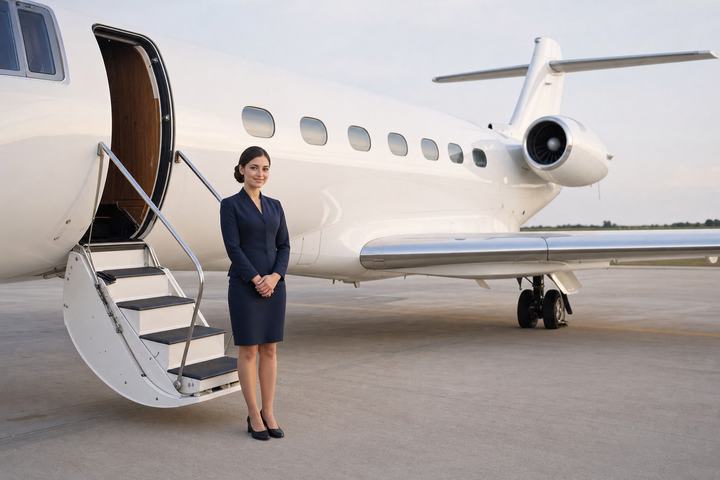
A jacket that fits just so, a crisp collar and an unhurried manner: in private aviation, the crew's appearance is noticed without ever drawing the eye. Your guests know the finest hotels and grand houses, and they expect the same quiet elegance on board. Here's the good news: that elegance is no accident, and it can be learnt like every other part of the job.
- Nobody will measure you: a polished turnout counts for far more than your height.
- One advert has the operator supplying the uniform and the crew member looking after it.
- Depending on the operator, some uniform and laundry costs may stay with you.
- Glassware and silverware are handled in white gloves, while platter service is done bare-handed.
- Discretion goes beyond clothing, since photos are generally off limits on board.
On this page
Why does presentation matter so much in private aviation?
Because it is part of the service itself. Presentation is one of the qualities that operators, the business aviation companies that run the jets, pay attention to. The specialist press also lists elegance, politeness and discretion among the qualities expected in the cabin.
Don't worry, this has nothing to do with your build. Private aviation sets no height requirement, and its crews are remarkably varied in age and background. What is expected of you is an immaculate turnout, worn with the same ease in the galley, the aircraft's compact kitchen, as at the aircraft door.
Who provides the uniform?
In the advert we read, the operator does, but it is well worth asking about costs. Placed by an operator based in the Middle East, that advert lists personal hygiene and appearance among the cabin crew's duties, along with the upkeep of the uniform provided.
An article in the specialist press, published in December 2024, adds some nuance. It explains that flight attendants in private aviation often cover some of their own costs, from uniform to laundry. Some operators do pick up part of the bill, but only now and then. Between those two cases, only your operator's offer will tell you what falls to you.
Top tip When you receive an offer, ask exactly what the operator provides: which uniform items, how many of each, and who pays for cleaning while you're away. You'll then know what to pack, and what to set aside for upkeep.
White gloves or bare hands?
Both, depending on the task. White gloves are worn for setting and handling glassware and silverware, so that crystal and metal stay free of a single fingerprint. Platter service, on the other hand, is done bare-handed, with the spoon and fork held together in one hand.
It's one of those details that tell you everything about a well-run cabin, and it belongs to Silver Service, the art of the table on board. The Silver Cabin Institute, linked to the publisher of The Crew Talk, offers online training in onboard service and Silver Service that you follow at your own pace. One-to-one mentoring then takes over, from your CV to preparing each interview, until your first flight and for up to a year.
How far does discretion go?
Well beyond what you wear. According to the same article, signing a confidentiality agreement is not unusual, and taking photos or videos on board is generally not allowed. Your uniform supports that restraint, since it lets you be present without ever putting yourself forward.
That discretion stays with you at the stopover too. During a rotation, you spend the nights between flights in a hotel paid for by the operator, and the uniform waits patiently for the next flight. Once service is over, at the stopover and at the hotel alike, you wear your own clothes.
How do you keep a uniform immaculate on rotation?
By treating it as part of your kit, looked after as the mission goes along. The advert mentioned above makes its upkeep the crew's responsibility, and the most common rotation is fifteen days on mission, during which home base can be a long way off.
So pack enough to last the whole mission, with a spare for the pieces that crease or mark quickly, and what you need to freshen them up at the hotel. Your roster, the crew's calendar, is often known months ahead. Your fifteen days off therefore leave plenty of time to have the uniform cleaned and to replace anything worn before you set off again.
What next?
- Packing for a rotation: the passport and entry formalities to check before you leave.
- Application photos: what to wear for the full-length photo operators ask for.
- Cabin crew jobs: this week's openings with operators.
Have a lovely flight, and see you on Monday for the new jobs: we can't wait to welcome you back to The Crew Talk.
The whole job: Cabin crew in private aviation →
Read next

Sources (3)
- ExecuJet Middle East (Luxaviation), advert "Cabin Attendant", Dubai, on startup.jobs (advert closed). startup.jobs, accessed 23 October 2026.
- GlobalAir.com, Patricia Green, "What does a private jet flight attendant actually do?", 30 December 2024. globalair.com, accessed 23 October 2026.
- The Silver Cabin Institute, blog (in French), "La vie à bord d'un jet privé : rotations, roster et journée type" (rotations, hotel nights during a mission, discreet presence). silvercabininstitute.com, accessed 23 October 2026.