The business aviation operator interview: what gets checked, and how to prepare
Before trusting you with its cabin, an operator wants to be sure of your English, your sense of safety, your service, your discretion and your availability. Here is what its adverts and application forms say, and the best way to prepare.
- The application form does a first sort, before you even meet anyone.
- Operators check your English, safety, service, discretion and availability.
- Recruiters across the sector most often put applicants to the test on Silver Service.
- Prepare a concrete example for each point, without ever naming your guests.
- Keep your certificates, a copy of your passport and your employment dates to hand.
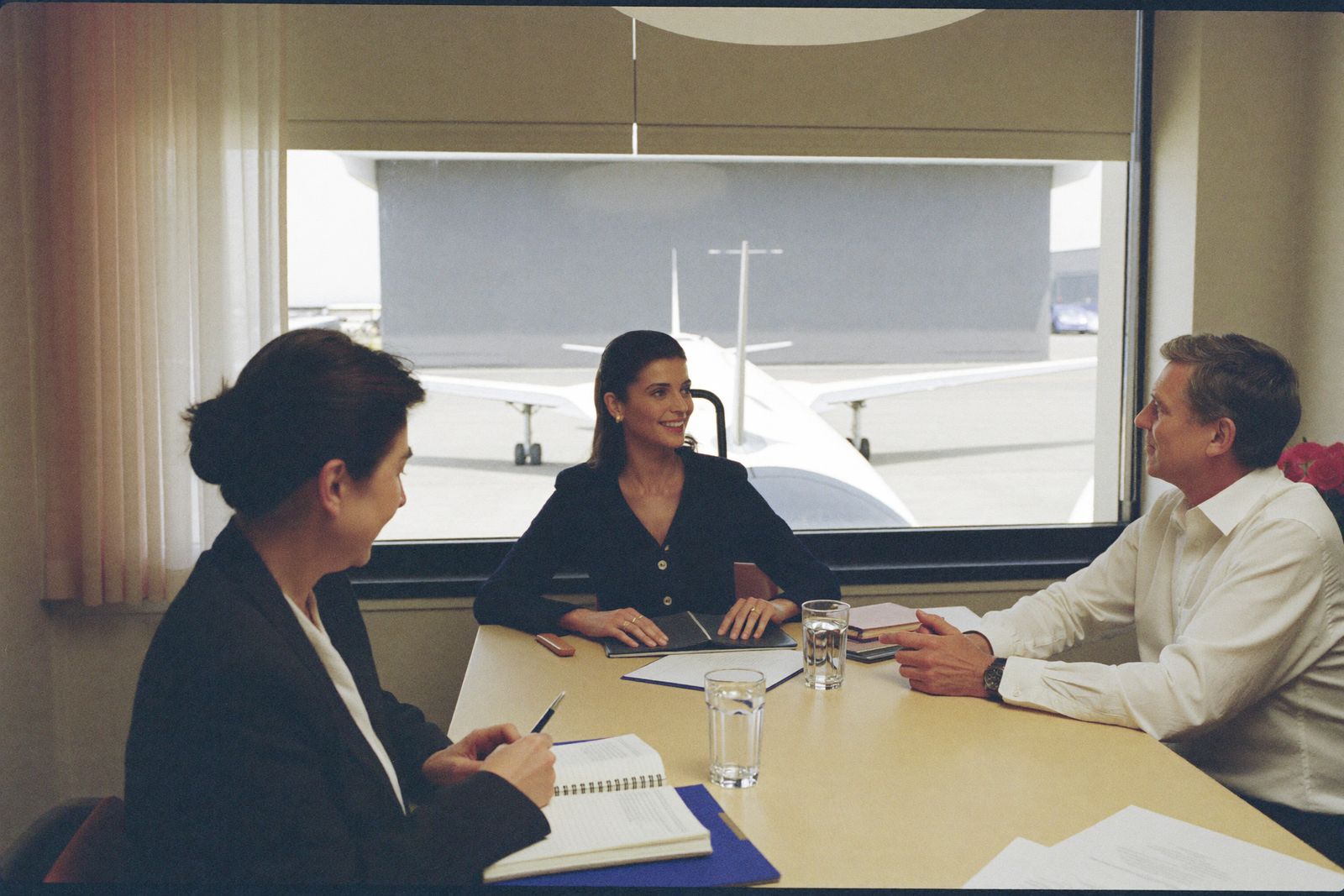
At an operator, one of the business aviation companies that run the jets, the interview starts well before you sit down with anyone. The application form already asks the questions that matter, and the conversation that follows explores your answers in more depth.
- The application form does a first sort, before you even meet anyone.
- Operators check your English, safety, service, discretion and availability.
- Recruiters across the sector most often put applicants to the test on Silver Service.
- Prepare a concrete example for each point, without ever naming your guests.
- Keep your certificates, a copy of your passport and your employment dates to hand.
On this page
The adverts are, in fact, fairly clear about what you will need to show. Five expectations come up again and again, and you can prepare for each one from your own career.
What happens before the interview?
The form does a first sort. For a VVIP cabin crew post, one operator's form asks for your years of flying, your certificates and your notice period. It also asks whether you can swim, and whether you are willing to move to where the post is based.
At another operator, your application then goes to the Flight Operations Manager, the person in charge of flight operations. Some recruits are hired straight away, while the others join a waiting list to come on board later.
A third operator's forms also invite you to add a short self-presentation video, should you wish to. It is a first chance to let them hear you, and our article on application photos explains how to approach it.
What does the operator check?
Each of these five is best shown through something you have actually done rather than simply claimed.
- Confident conversational English, the working language on board, sometimes alongside another language, such as Russian for one post.
- Safety and security, the latter meaning protection against deliberate harm: one operator expects the highest standard in both.
- Service, personal and discreet, anticipating each guest's preferences.
- Discretion, with absolute confidentiality around very high-profile guests.
- Availability, or the willingness to accompany your guests wherever they fly.
Why does service carry so much weight?
Because it is what guests see, and it is what recruiters pay closest attention to. Silver Service, the whole art of table service on board, from laying the table to silverware and etiquette, is where recruiters in the sector most often assess applicants.
One advert describes the work expected in some detail. It means ordering the catering, the food and drink chosen for the flight, looking after guest amenities and arranging bespoke requests on board.
None of this can be improvised on the day of the interview: it comes from proper training, which operators value highly. If you come from a luxury hotel, a fine dining restaurant or a superyacht, your experience is a real strength, and training teaches you to carry it into the cabin.
How do you talk about discretion?
With restraint, since that is exactly what is being assessed. One operator speaks of loyalty and of earning the trust of a very high-profile clientele, which means being able to describe your work without giving anything away.
So prepare a way of talking about your experience without mentioning names, or any detail about the people you have looked after. The way you talk about it already shows how you will behave on board.
What should you say about availability?
A clear answer, prepared in advance. Depending on the post, the operator asks for your notice period, or whether you will take up a base in the city where the post is.
The roster is part of the conversation too, and the most common rotation is fifteen days on mission followed by fifteen days entirely free. Other patterns exist, such as twenty days on duty for ten days off in an advert that closed in February 2026. Simply say that the post's rhythm suits you, and from what date you can start.
Employers also look at your long-term commitment, a concern raised by the US business aviation association in its May/June 2026 magazine. So say clearly what draws you to business aviation.
Which documents should you have to hand?
The ones the forms ask for, all of which are compulsory at one of the operators whose advert we read.
- Your certificates, from your initial cabin crew training and from your service training.
- A recommendation letter confirming your cabin experience, if you have already flown in private aviation.
- A copy of your passport.
- Your employment dates, with the name of your last VIP employer.
Top tip For each of the five expectations, prepare a precise example from your own career that you can tell in English without naming anyone. And if your application goes on a waiting list, let the operator know as soon as your availability changes.
To prepare for this step, you can turn to The Silver Cabin Institute, linked to the publisher of The Crew Talk. Its online training in onboard service and Silver Service is taken at your own pace. One-to-one mentoring then takes over and prepares every interview with you by video call, until your first flight and for up to a year.
What next?
- Silver Service: what it covers, and why it matters so much at interview.
- The business aviation CV: one page that makes recruiters want to meet you.
- Cabin crew jobs: this week's openings with operators.
New jobs and fresh articles appear on The Crew Talk every Monday, so do come back and see us soon.
The whole job: Cabin crew in private aviation →
Read next

Sources (5)
- Comlux, advert "VVIP Cabin Crew – Dubai Base", published on 18 May 2026, and its application form. comlux.bamboohr.com, accessed 18 October 2026.
- Global Jet Luxembourg, adverts published on its Recruitee careers page ("VIP Flight Attendant - Geneva based", "Nice based", "Dubaï based", "Russian speaker") and their application forms. globaljetluxembourg.recruitee.com, accessed 18 October 2026.
- MJET, advert "Experienced Service/Cabin Crew Member", closing date 15 February 2026. mjet.eu, accessed 18 October 2026.
- Solairus Aviation, advert "Gulfstream G700 Flight Attendant - San Jose, CA". careers-solairus.icims.com, accessed 18 October 2026.
- NBAA (National Business Aviation Association), Business Aviation Insider, May/June 2026, "Business Aviation Offers Former Airline Workers Valuable Opportunities". nbaa.org, accessed 18 October 2026.