Becoming a cabin crew instructor with an airline
A cabin crew instructor trains airline cabin crew, from the CCA course through to each airline's own procedures. Here is who qualifies these trainers, the route set out by the Maltese authority and where the job is done.
- Each airline or approved training organisation chooses and qualifies the trainers it uses.
- European rules set no number of flying years or teaching hours.
- In Malta, you need a CCA or recognised expertise, then training in teaching.
- Malta requires one year of senior cabin crew experience before you can instruct in flight.
- Job adverts list the role under the title Cabin Crew Instructor.
If you already have cabin experience and enjoy passing on what you know, becoming a cabin crew instructor can be a natural next step. Unlike pilot instructors, you need no certificate of your own to train cabin crew. The approved training organisation or airline selects you and qualifies you, following a programme the authority has approved.
- Each airline or approved training organisation chooses and qualifies the trainers it uses.
- European rules set no number of flying years or teaching hours.
- In Malta, you need a CCA or recognised expertise, then training in teaching.
- Malta requires one year of senior cabin crew experience before you can instruct in flight.
- Job adverts list the role under the title Cabin Crew Instructor.
On this page
What does a cabin crew instructor do?
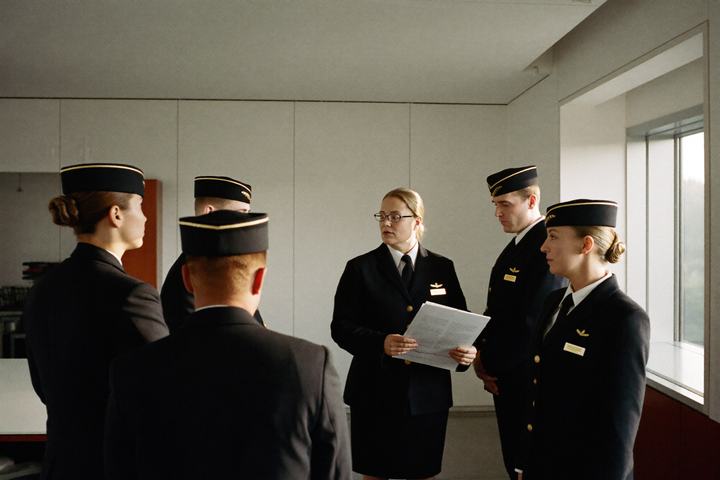
Instructors train cabin crew at two points in their career. The first is the initial course that leads to the CCA, the certificate you need to fly as cabin crew with an airline. The second covers the courses each airline then runs on its own aircraft and procedures. Lessons take place in a classroom, real or virtual, and part of the instruction can also be given in flight.
What are the requirements?
Little is written down for the trainer personally. The European cabin crew rules ask for trainers who are suitably experienced and qualified for what they teach, without setting any figure for years of flying or hours of teaching.
The conditions are mostly about the organisation that does the training.
- Training is given by a training organisation or a commercial air transport operator, such as an airline, approved for this by the authority.
- It follows a programme and syllabus set out in that organisation's approval.
So it is the employer that decides what it means by experienced and qualified, within the programme the authority approves. Other texts from EASA, the European Union Aviation Safety Agency, also deal with some trainers in particular, such as the CRM trainer.
CRM, or crew resource management, is about how a crew works together. Finally, every airline holding an air operator certificate names a person, nominated to the authority, who answers for crew training.
What route does the Maltese authority set out?
Transport Malta, the Maltese civil aviation authority, has written down precisely what it expects of cabin crew trainers, in a notice revised on 12 January 2023. It applies to cabin crew training organisations and to airlines approved for initial training and the issue of the CCA.
The route it describes comes down to four steps.
- Hold a CCA, or be a recognised expert in the subject you teach.
- Complete training in teaching skills, such as a train-the-trainer course.
- Give a test lecture before you teach, on material you have prepared yourself.
- Have at least one year's experience as a senior cabin crew member to instruct in flight, the senior cabin crew member being the person who leads the cabin crew.
Once in post, you take refresher training at intervals set by the airline, and you attend a yearly meeting that keeps trainers' teaching consistent.
Two subjects call for an extra qualification. For dangerous goods, you need competency-based training in line with the texts of ICAO, the International Civil Aviation Organization. For CRM, you need to be a qualified CRM trainer.
Examiners, for their part, have extensive experience as instructors, and the person who delivered a course does not examine it, unless procedures are in place to prevent conflicts of interest. The names of instructors and examiners are kept in the training manual, or in the training part of the operations manual.
Any qualification considered equivalent must be submitted to the authority before you start teaching. Malta is, after all, only one example, and each authority may set out its own expectations.
Good to know Only in-flight instruction needs the year as senior cabin crew member. To teach in the classroom in Malta, the first three steps are enough, so you can start passing on your knowledge before you have led a cabin.
Where do cabin crew instructors work?
A cabin crew instructor works in two kinds of organisation, starting with those the authority has approved for initial CCA training, whether training organisations or airlines. Then come the airlines themselves, for the courses they run on their own aircraft and procedures.
In adverts, the job is called Cabin Crew Instructor, a title you can use just as it stands in your job searches.
Top tip Before you apply, ask the organisation or airline how it qualifies its trainers. It sets that out in the programme the authority has approved, so you will know exactly which training to aim for.
What next?
- The CCA explained simply: what it is for, how to get it and how long it remains valid.
- Cabin crew at an airline: the job you will be teaching, and what airlines ask of their new recruits.
- The airline directory: each airline's careers page, so you can look for this role at the source.
Do come back on Mondays: fresh articles will be waiting for you on The Crew Talk.
Read next
Sources (5)
- EASA, Easy Access Rules for Aircrew, CC.TRA.215 Provision of training. easa.europa.eu, accessed 17 October 2026.
- Transport Malta, Civil Aviation Directorate, OAN 04/17 Qualification Requirements for Cabin Crew Instructors / Examiners, Revision 4, 12 January 2023. transport.gov.mt, accessed 17 October 2026.
- EASA, Consolidated unofficial AMC/GM to Annex III (Part-ORO), February 2016. easa.europa.eu, accessed 17 October 2026.
- EASA, Easy Access Rules for Air Operations, ORO.AOC.135 Personnel requirements. easa.europa.eu, accessed 17 October 2026.
- Regulation (EU) No 965/2012 on air operations, Annex III (Part-ORO), consolidated version. eur-lex.europa.eu, accessed 17 October 2026.